

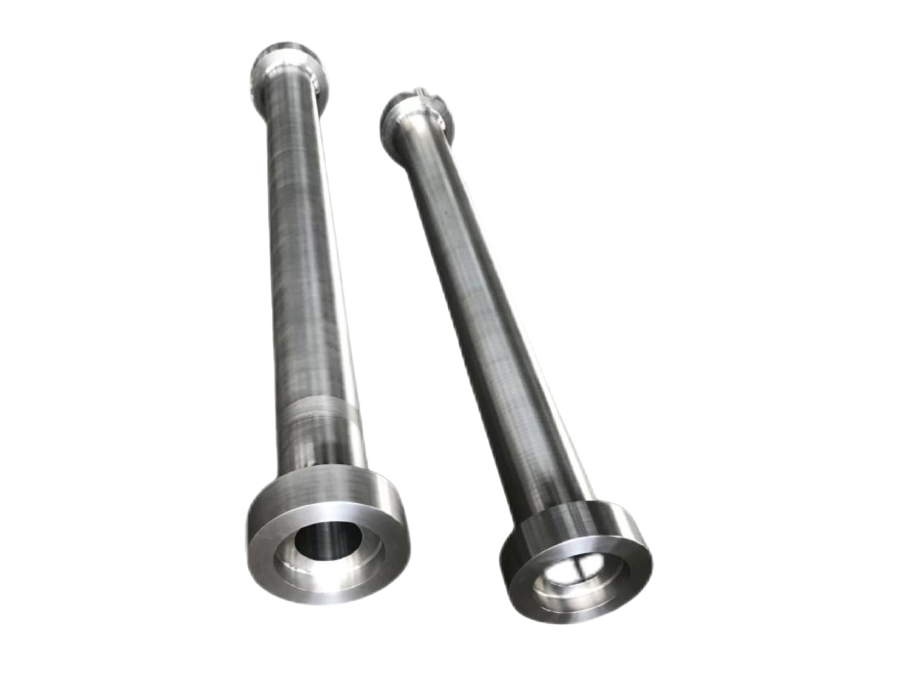
UNSS66286 driven shaft with flange
For any temperature and concentration of hydrochloric acid has excellent corrosion resistance. At the same time, it has good corrosion resistance to sulfuric acid, acetic acid, formic acid, phosphoric acid and other non-oxidizing media.
Classification:
Product Display
Key words: nickel-based alloy material
- DESCRIPTION
-
Overview
Precipitation hardenable alloy with high mechanical properties. The alloy maintains good strength and oxidation resistance up to 700°C. High strength and excellent machinability make it suitable for various aviation and industrial gas turbine components, including blades, shafts, tail cones, reburner chambers, springs and fasteners. The alloy is also used in the automotive field
Chemical composition
Nickel: 24-27 Chromium: 13.5-16 Molybdenum: 1.0-1.5 Boron: 0.001-0.01 Iron: Balance Aluminum: 0.35 Titanium: 1.9-2.35
Carbon: 0.08 Manganese: 2.0 Silicon: 1.0 Vanadium: 0.1-0.5 Sulfur: 0.03Characteristics
It has high yield strength and endurance, creep strength below 650°C, good processing plasticity and satisfactory welding performance.
Applications
Widely used in the manufacture of parts for aircraft engines and industrial gas turbines, such as turbine blades, afterburners, fasteners, etc., and also widely used in automobile engines. Aircraft engine high-temperature load-bearing parts that work for a long time below 650°C, such as turbine disks, etc.
A nickel-chromium-molybdenum alloy with the addition of niobium, which acts with molybdenum to harden the alloy matrix, thereby exhibiting high strength properties without heat treatment. The alloy is resistant to various harsh corrosive environments, especially pitting and crevice corrosion. It is used in chemical, aviation and marine engineering, pollution control equipment, and nuclear reactors.
The low carbon alloy 625 after softening annealing is widely used in the chemical process industry, and its good corrosion resistance and high strength make it can be used as a thin structural component. 625 alloys can be applied in contact with seawater and subjected to high mechanical stress. Typical application areas:
1. Components of organic chemical processes containing chlorides, especially where acid chloride catalysts are used;
2. For the manufacture of digesters and bleaching ponds for the pulp and paper industry;
3. The absorption tower, reheater, flue gas inlet baffle, fan (wet), agitator, deflector and flue in the flue gas desulfurization system;
4. For the manufacture of equipment and components used in acid gas environments;
5. Acetic acid and acetic anhydride reaction generator;
6. Sulfuric acid condenser.
Related Products
Online Message

Nickel-based alloy material production experts
© 2024 Shanghai Fengqu Super Alloy Co., Ltd. All Rights Reserved